

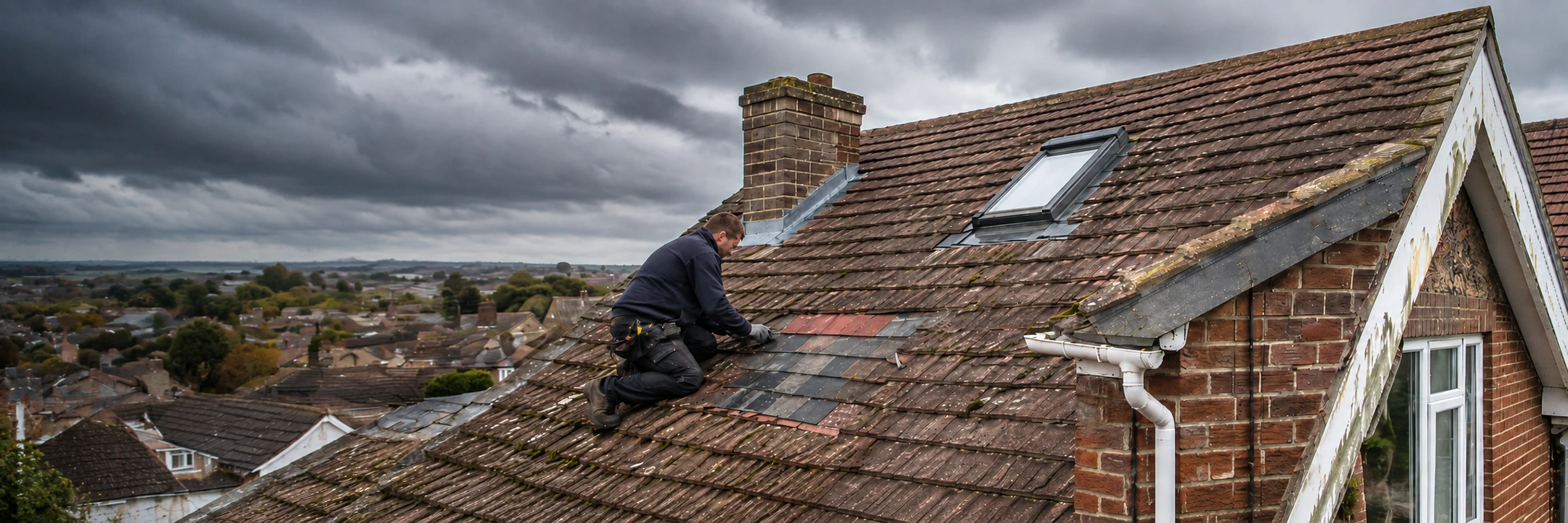
The brown mark on the ceiling is not always caused by the spot of rain falling right above it. Water coming in through the roof will flow all the way down rafters, membranes, insulation, and drip somewhere in sight. The source of the leak is sometimes coming from elsewhere. It may be halfway across the room or more distant than that. Knowing how to trace the actual roof leak causes is what makes the difference between a real solution and one that falls apart after six weeks. Knowing how to trace the actual cause of a leak is what makes the difference between a real solution and one that fails after a few weeks. Professional roofers in Kent can investigate the roof covering, flashing, drainage and underlying structure to identify where water is entering.
Faulty or Missing Tiles
Broken, cracked, or dislodged tiles result in direct entry points for water to enter. This is brought about by wind, impacts, and freeze/thaw. In the case of a faulty tile, it should be replaced instead of repairing it with sealant. It is also important to inspect the roofing felt and battens underneath, as water may have already reached these areas and caused further damage. This is an important roof tiling insight for Kent homeowners.
Faulty Flashings
Flashing is used to create a seal at the point where the roof meets other things, such as chimneys, skylights, and dormers. After some time, the flashing will crack, corrode, or lift off and thus allow water to enter the tiles. Sometimes separation allows the opportunity for sealing, but otherwise, replacement is required.
Blocked Gutters and Roof Valleys
The role of gutters is to ensure that the water flows off the roof safely. If the gutters get blocked, water will flow up to the roofline and find any weak areas within the roofing material. Valleys in the roof are where water accumulates in large volumes; if debris blocks them, the water will go underneath the roof shingles. It is easy maintenance and helps to avoid costly repairs.
Problems with Chimney
There are multiple leaks that occur because of chimneys: cracked mortar joints, spalling bricks, and damaged flashing around the chimney’s base. A clue to the existence of problems in the chimney area is dampness in the vicinity of the chimney breast inside the building.
Damaged Underlay
This is the secondary barrier, not the main barrier. If it is torn or worn out, the water that passes through the tiles gets to the wooden structure. Repairing it requires lifting the surrounding roof covering from outside; it cannot be accessed or fixed from within the loft space.
Skylight and Vent Seals
Perimeter seals around skylights dry and crack quietly over years. The glass or frame rarely fails first; the flashing around the frame does. Vent collars on roof penetrations develop the same problem as rubber degrades with UV exposure and temperature cycling.
Misinterpretation of Condensation for Leakage
The rising warm air from within a building forms moisture in the cold roof space due to poor ventilation. This causes wet spots that cannot be distinguished from rain leakage. Improving loft airflow and checking that insulation has not blocked soffit vents resolves it; replacing tiles does not.
RW Roofing & Property Services Ltd offers roof repairs Ashford and throughout Kent, from individual tile replacement and lead flashing work to chimney repointing and full leak investigations. For those requiring roof repairs Herne Bay, roof repairs Maidstone, or roof repair Canterbury, Richard has over ten years of trade experience and offers free on-site assessments for both domestic and commercial properties.